

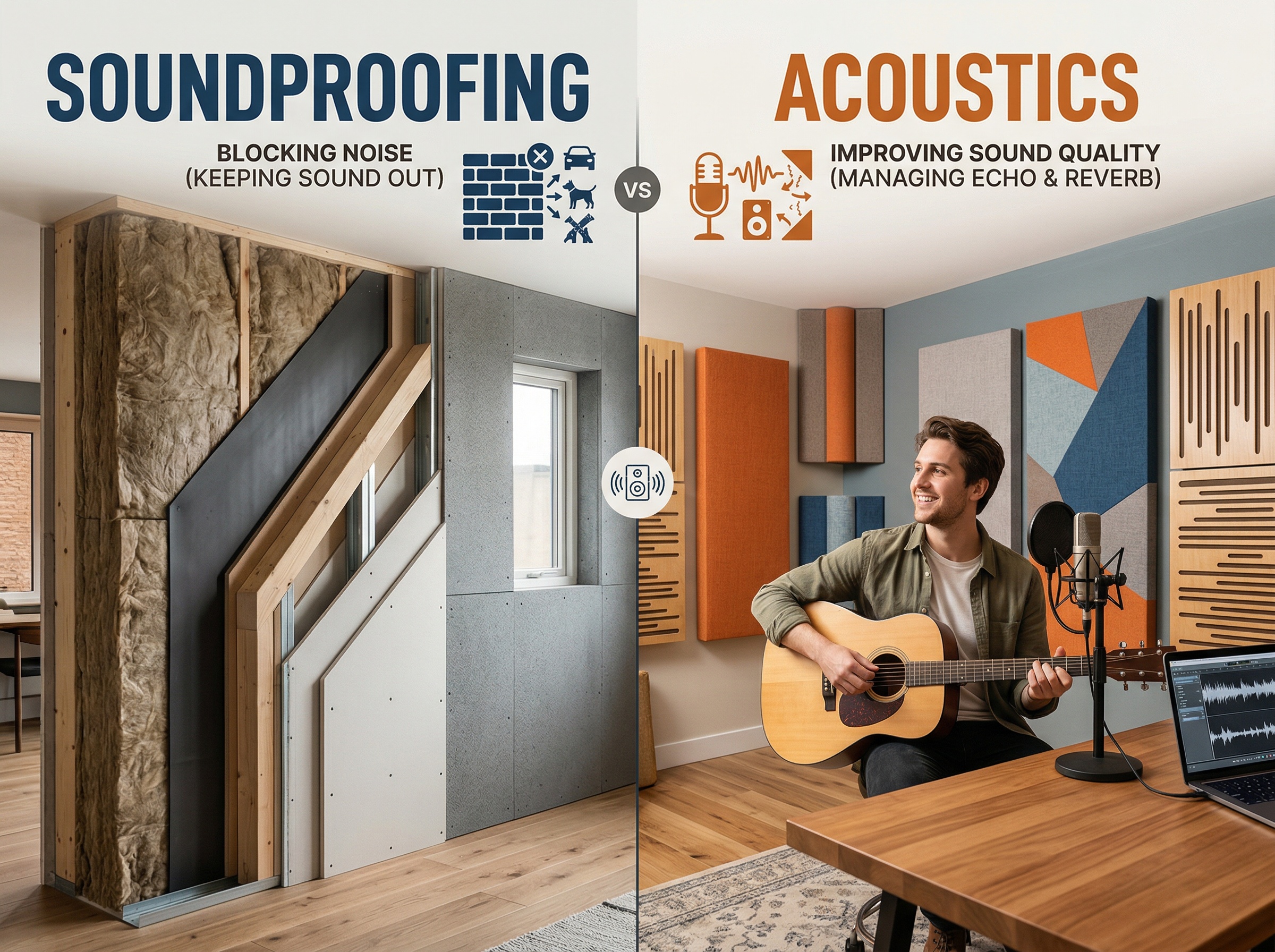
Soundproofing focuses on blocking sound transmission between spaces, preventing noise such as voices, music, or traffic from passing through walls, floors, or ceilings. It relies on key principles of isolation through added mass, decoupling, absorption and airtight sealing.
This approach is best addressed during the design phase for new construction or major renovations, where solutions can be integrated efficiently and cost-effectively. Retrofitting soundproofing is possible in existing buildings, but it is typically extremely invasive, significantly more expensive, and the success of the outcome depends heavily on the existing conditions of the structure as well as the available budget.
Acoustics, in contrast, enhances sound quality within a single space by controlling reflections, echo, and reverberation to deliver clearer, more balanced sound. Absorptive or diffusive materials effectively reduce unwanted internal effects, but they do not prevent sound from entering or exiting the room.
Defining and implementing acoustic solutions is typically much more fluid than soundproofing, as it depends heavily on the specific needs and characteristics of the project. In many cases, acoustics can be designed and installed when the build is nearly complete. However, for projects that rely heavily on acoustic performance, such as home theaters, auditoriums, churches, recording studios, and similar spaces, the planning and integration need to happen very early in the design process to achieve optimal results.
Comments are closed.